Monolog — Logs
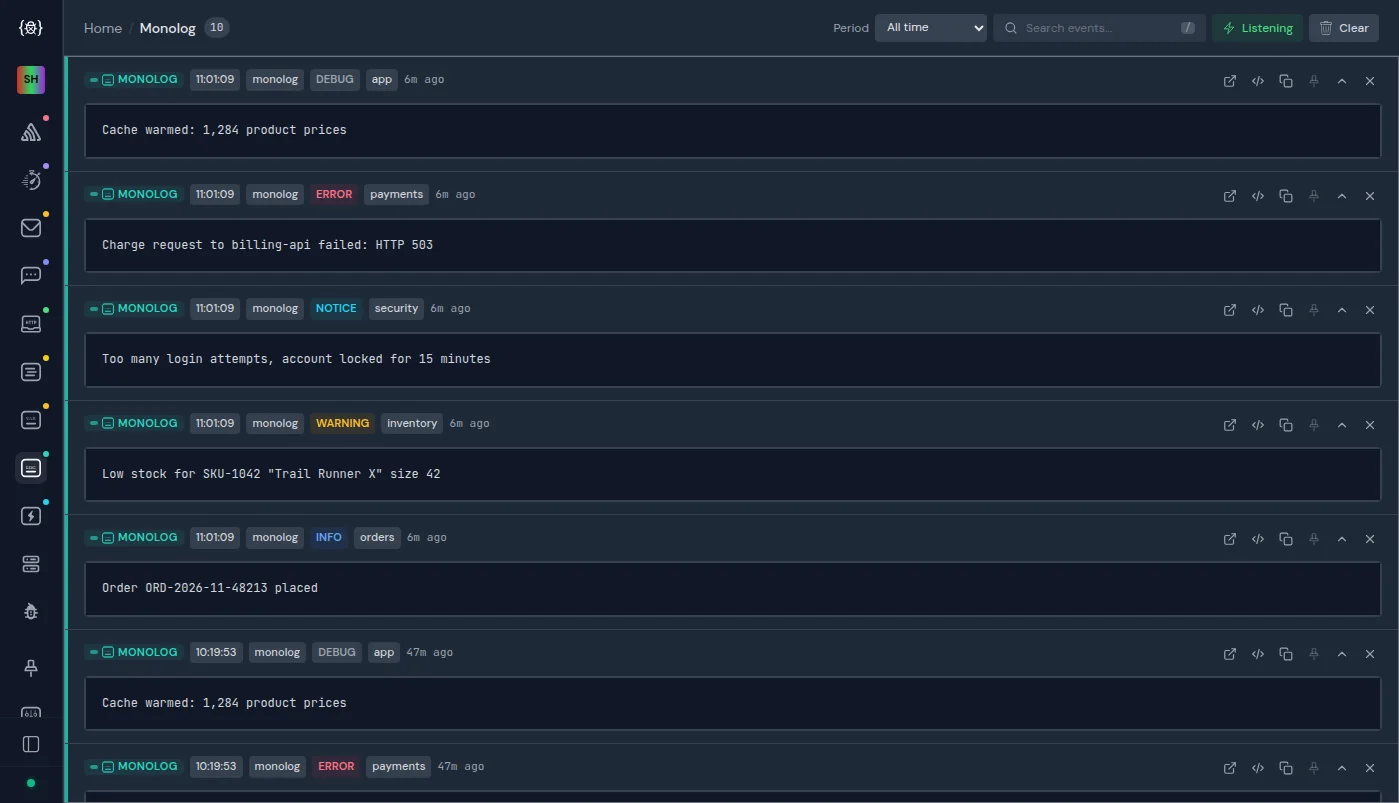
Your app writes logs — but where do they go during development? A file you tail -f? Docker container output you scroll through? With Buggregator, logs from all your services land in the same UI where you already see exceptions, dumps, and emails. Search by message, channel or level, read the context as JSON, and see the file and line that wrote a record when it sends them — all without setting up Elasticsearch or a separate logging stack.
Use cases
- Structured log viewer — see context and extra fields as formatted JSON, not a raw string in a terminal.
- Multi-service logging — collect logs from all containers in one place.
- Debug long-running apps — workers, daemons, and queue consumers write logs that are easy to miss in stdout. Buggregator catches them all.
- All in one place — see logs in the same UI as your exceptions and dumps.
What you see in the UI
- Channel — the logger channel (
app,security,database, etc.). - Message — the log message.
- Severity level — all PSR-3 levels: emergency, alert, critical, error, warning, notice, info, debug.
- Timestamp — when the log was recorded.
- Context — structured context data in JSON format.
- Extra fields — additional data from Monolog processors. With
Monolog\Processor\HostnameProcessorthe log gets the machine name, and you can filter the feed by it. - Source — file, line, and function where the log was generated, when the record has a
sourcekey in its context.
To read logs as one stream with search, a per-minute chart and all lines of one request, open the Logs screen.
Configuration
Buggregator receives logs via Monolog's SocketHandler on port 9913. The formatter must be JsonFormatter.
In Docker Compose, replace
127.0.0.1with the Buggregator service name (e.g.,buggregator:9913).
Laravel
// config/logging.php
return [
    // ...
    'channels' => [
        // ...
        'socket' => [
            'driver' => 'monolog',
            'level' => env('LOG_LEVEL', 'debug'),
            'handler' => \Monolog\Handler\SocketHandler::class,
            'formatter' => \Monolog\Formatter\JsonFormatter::class,
            'handler_with' => [
                'connectionString' => env('LOG_SOCKET_URL', '127.0.0.1:9913'),
            ],
        ],
    ],
];LOG_CHANNEL=socket
LOG_SOCKET_URL=127.0.0.1:9913Spiral Framework
<?php

declare(strict_types=1);

namespace App\Bootloader;

use Monolog\Formatter\JsonFormatter;
use Monolog\Handler\SocketHandler;
use Spiral\Boot\Bootloader\Bootloader;
use Spiral\Boot\EnvironmentInterface;
use Spiral\Monolog\Bootloader\MonologBootloader;

class LoggingBootloader extends Bootloader
{
    public function init(MonologBootloader $monolog, EnvironmentInterface $env): void
    {
        $handler = new SocketHandler($env->get('MONOLOG_SOCKET_HOST'), chunkSize: 10);
        $handler->setFormatter(new JsonFormatter(JsonFormatter::BATCH_MODE_NEWLINES));
        $monolog->addHandler('socket', $handler);
    }
}MONOLOG_DEFAULT_CHANNEL=socket
MONOLOG_SOCKET_HOST=127.0.0.1:9913Symfony
# config/packages/dev/monolog.php
<?php

namespace Symfony\Component\DependencyInjection\Loader\Configurator;

use Symfony\Config\MonologConfig;

return static function (MonologConfig $monologConfig): void {
    $monologConfig
        ...
        ->handler('socket')
            ->level('debug')
            ->formatter('monolog.formatter.json')
            ->type('socket')
            ->connectionString(env('MONOLOG_SOCKET_HOST'));
};MONOLOG_SOCKET_HOST=127.0.0.1:9913Important: The
monolog.formatter.jsonformatter is required. Without it, Buggregator cannot parse the log records.
Any PHP project
composer require monolog/monolog<?php
use Monolog\Logger;
use Monolog\Handler\SocketHandler;
use Monolog\Formatter\JsonFormatter;
$log = new Logger('buggregator');
$handler = new SocketHandler('127.0.0.1:9913');
$handler->setFormatter(new JsonFormatter());
$log->pushHandler($handler);
$log->warning('Foo');
$log->error('Bar');