Configuration — Projects
Buggregator lets you use "projects" to help organize your data. Projects are useful for keeping events from different teams, applications, or environments separate.
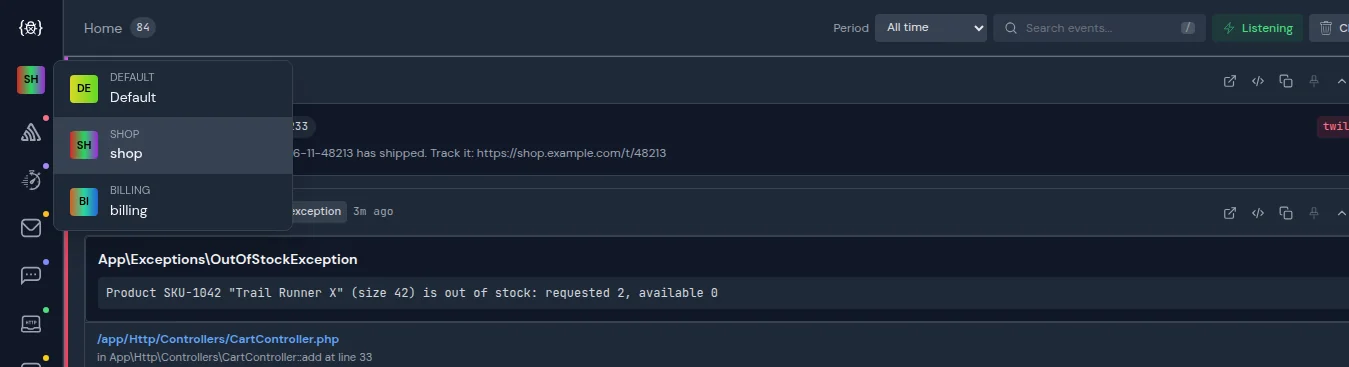
Here's why you might want to use projects:
- Projects help you keep data from different teams or parts of your app separate. This means it's easier to find what you're looking for and keep track of changes.
- Teams won't get mixed up with data that isn't relevant to them, which makes their work faster and less confusing.
- The sidebar displays a project selector dropdown, allowing you to quickly switch between projects and view only the events relevant to the selected project.
Default Project
When you start the server, Buggregator automatically sets up a default project with key default. All your data goes into this default project if a project key is not specified in the request.
Configuration
Projects are configured in buggregator.yaml:
projects:
  - key: my-app
    name: My Application
  - key: staging
    name: Staging Environment
  - key: mobile
    name: Mobile App
Docker Compose Example
services:
  buggregator:
    image: ghcr.io/buggregator/server:latest
    ports:
      - 127.0.0.1:8000:8000
    volumes:
      - ./buggregator.yaml:/buggregator.yaml
With buggregator.yaml:
projects:
  - key: backend
    name: Backend API
  - key: frontend
    name: Frontend App
Sentry Configuration
To use Sentry with your project, format your DSN like this:
SENTRY_DSN=http://sentry@127.0.0.1:8000/<project_key>A numeric last segment (/1) is the SDK's own project id and sends events to default. If your SDK accepts only numbers there, send both X-Buggregator-Event: sentry and X-Buggregator-Project: <project_key>; the project header alone is ignored for Sentry SDK requests.
Note: Read more in Sentry → Projects.
Mock Server
Rules can be limited to one project, and requests choose their project with the X-Buggregator-Project header or Basic Auth mock:<project_key>. See Mock Server → Projects.
Projects created on the fly
A project key that is not in buggregator.yaml is added to the list when its first event card arrives, with the key as its name. Example: an error sent to http://sentry@127.0.0.1:8000/billing adds the project billing. Sentry traces, logs and metrics make no card, so a project that gets only those is not added: list it in buggregator.yaml.
Inspector Configuration
To use Inspector with your project, format your DSN like this:
INSPECTOR_URL=http://inspector:<project_key>@127.0.0.1:8000
INSPECTOR_API_KEY=<secret_key>
Note: Read more about Inspector configuration here.
Xhprof Profiler Configuration
To set up the Profiler, use this:
PROFILER_ENDPOINT=http://profiler:<project_key>@127.0.0.1:8000Note: Read more about Xhprof Profiler configuration here.
Ray Configuration
For Ray, use these settings:
RAY_HOST=ray:<project_key>@127.0.0.1
RAY_PORT=8000
VarDumper Configuration
A dump goes to the project named by the project key of its context. A plain dump() has no such key, so it lands in default.
Monolog Configuration
A log record goes to the project named by project in its context:
$logger->error('Payment failed', ['project' => 'shop']);Records without it land in default.